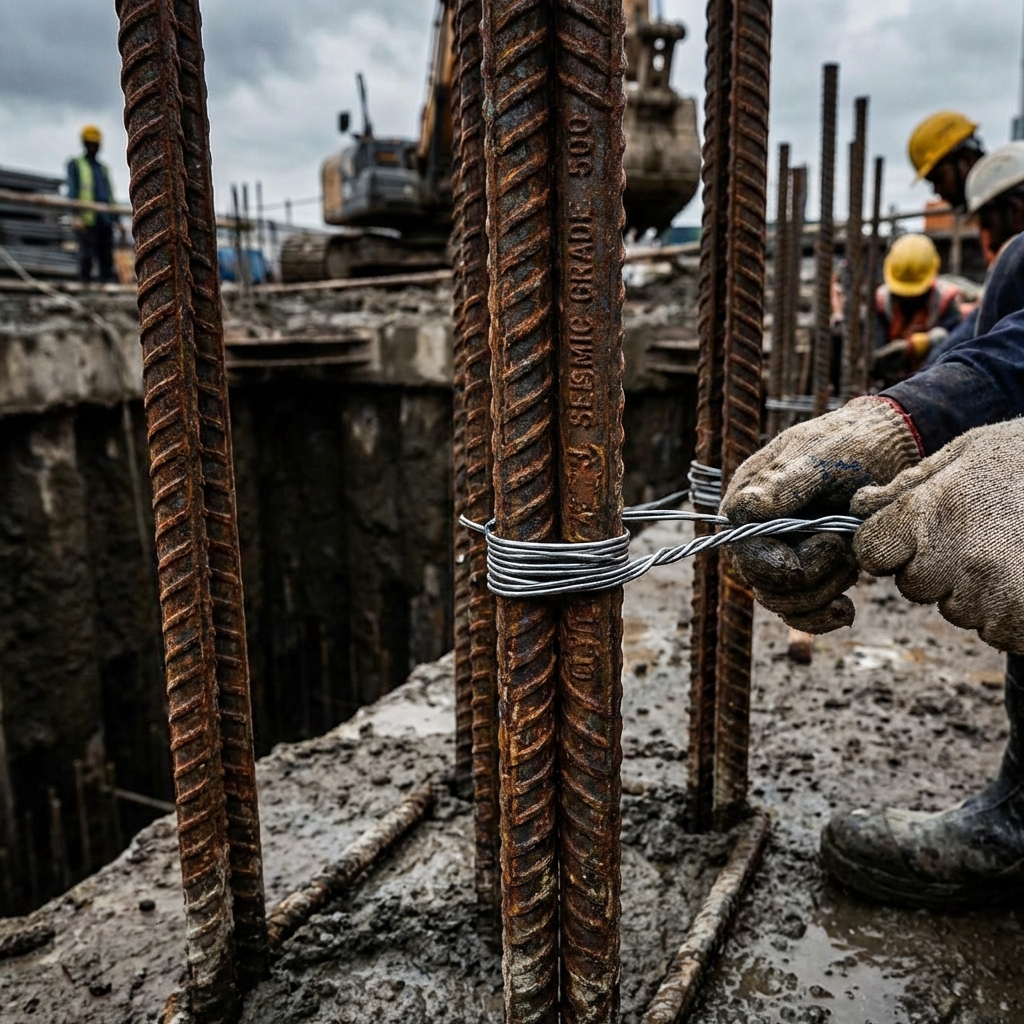
Footings, columns, beams, slabs and stirrups each use different TMT bar diameters. This guide explains common practice in residential work, and why your engineer's drawing always comes first.
Always start with the drawing
Bar sizes in a house are not a matter of preference. They are fixed by the structural engineer's drawing, which accounts for your soil, number of floors, spans and loads. The guidance here describes what is commonly seen in ordinary residential work in Tamil Nadu so you can follow what the drawing says and check what arrives on site. If anything in this article differs from your engineer's drawing, follow the drawing. Never reduce bar size or count on site to save money, because the saving is small and the risk is large.
Footings and columns
Footings are commonly reinforced with bars in the 10 mm to 16 mm range laid in a mesh at the bottom, with 12 mm a frequent choice for small houses. Columns carry the main vertical load and generally use 12 mm to 16 mm main bars, with the larger size at corners or in two-storey houses. The vertical bars are held in place by ties or stirrups, usually 8 mm, spaced closely near the top and bottom of each column. The close spacing is important for strength during loading and for earthquake performance.
Beams and the roof slab
Plinth and roof beams commonly use 12 mm to 16 mm main bars at the top and bottom, tied with 8 mm stirrups. The roof slab commonly uses 8 mm or 10 mm bars in both directions, at spacing set by the drawing, with extra bars at supports. Sunshades and small projections often use 8 mm bars, because they are light, but cantilevers carry load in an unusual way and need the exact detail from the engineer. Bar placement and cover matter as much as diameter. Bars should also be bent and tied exactly as the bending schedule shows.
Grade and quality
TMT bars are sold in grades such as Fe 500, Fe 500D and Fe 550D, and your drawing will say which. The D stands for higher ductility, which means the bar bends and stretches more before breaking, a useful property in earthquakes. Check that each bar carries the manufacturer's embossed marking, that the surface is clean and ribbed, and that it is free of heavy flaking rust. Light surface rust is normal and usually acceptable, but loose scale is not. Reject bars that are bent, cracked at the ribs or visibly different in diameter from what you ordered.
Weight and ordering
The weight per metre of a bar is approximately the diameter in millimetres squared divided by 162. A 12 mm bar therefore weighs about 0.89 kg per metre and an 8 mm bar about 0.40 kg per metre. Bars are commonly supplied in 12 metre lengths, so ordering to lengths from your bar bending schedule cuts waste. As a thumb rule, a 1,000 sq ft RCC house uses about 3,500 to 4,000 kg of steel, but your schedule is the number to follow. Weigh a sample bar bundle if you doubt the delivered quantity.
Use the TMT bar weight calculator
Our TMT bar weight calculator converts diameter, length and number of bars into kilograms, so you can total the steel from your drawing. Compare the total with the thumb rule above as a quick sanity check. You can also use it in reverse: enter the kilograms you received and check that the total matches the invoice, which is a quick safeguard against short weight. For the wider budget, our construction cost guide shows where steel sits among the main cost items. We list TMT bars of Fe 500 and Fe 550D grade, and availability and rates are confirmed when you call.
Conclusion
Common practice gives a feel for where each diameter goes, but the structural drawing decides. Check grade, markings and quantity on delivery, and never swap bar sizes on site without your engineer. Share your bar schedule and we will help you total the weight. Our team can also advise on the grades available. Call or WhatsApp +91 76676 66264 for delivered rates.
Reviewed by the TKR team. See our editorial policy for how guides are written, checked and updated.