A good floor starts below the tile. This guide explains compacted filling, gravel layer, PCC and cement bedding for ground floors in Tenkasi homes so tiles stay level and do not crack or sound hollow.
Why the base matters more than the tile
Most cracked or hollow-sounding floors fail because of what lies underneath, not because of the tile itself. A ground floor sits on soil, and soil that settles unevenly drags the floor with it. Moisture rising from the ground can also damage the finish over time. A proper base spreads the load, keeps the surface level and slows dampness. The usual build-up from the bottom is compacted earth filling, a gravel or aggregate layer, plain cement concrete, a cement bedding and finally the tile. Your engineer's drawing sets the thickness of each layer.
Earth filling and compaction
Remove topsoil, roots and organic matter from inside the plinth. Fill with clean, non-clayey soil or approved filling in layers of roughly 150 to 200 mm, wetting and compacting each layer before adding the next. Hand rammers work on small rooms and a plate compactor on larger areas. Skipping compaction or filling in one thick layer leaves hidden soft spots that settle after the floor is finished. Gravel and kundu kal are commonly used for filling, and our building material rate checker lists them, subject to availability and reconfirmation. Whatever the layer, keep the work dry and clean so mud does not get trapped inside the build-up.
Gravel or aggregate layer
A layer of gravel or coarse aggregate over the compacted fill breaks the capillary path that draws ground moisture upward and gives an even, firm working surface. Spread it to the thickness your engineer specifies, level it with string lines or pegs, and ram it so the stones lock together. Keep it free of mud and loose soil. In damp locations or where the water table is high, some designers add a plastic sheet above this layer, so ask your engineer whether it is advised for your plot. Use the same gravel or kundu kal for patches so the layer stays even across the room.
PCC layer
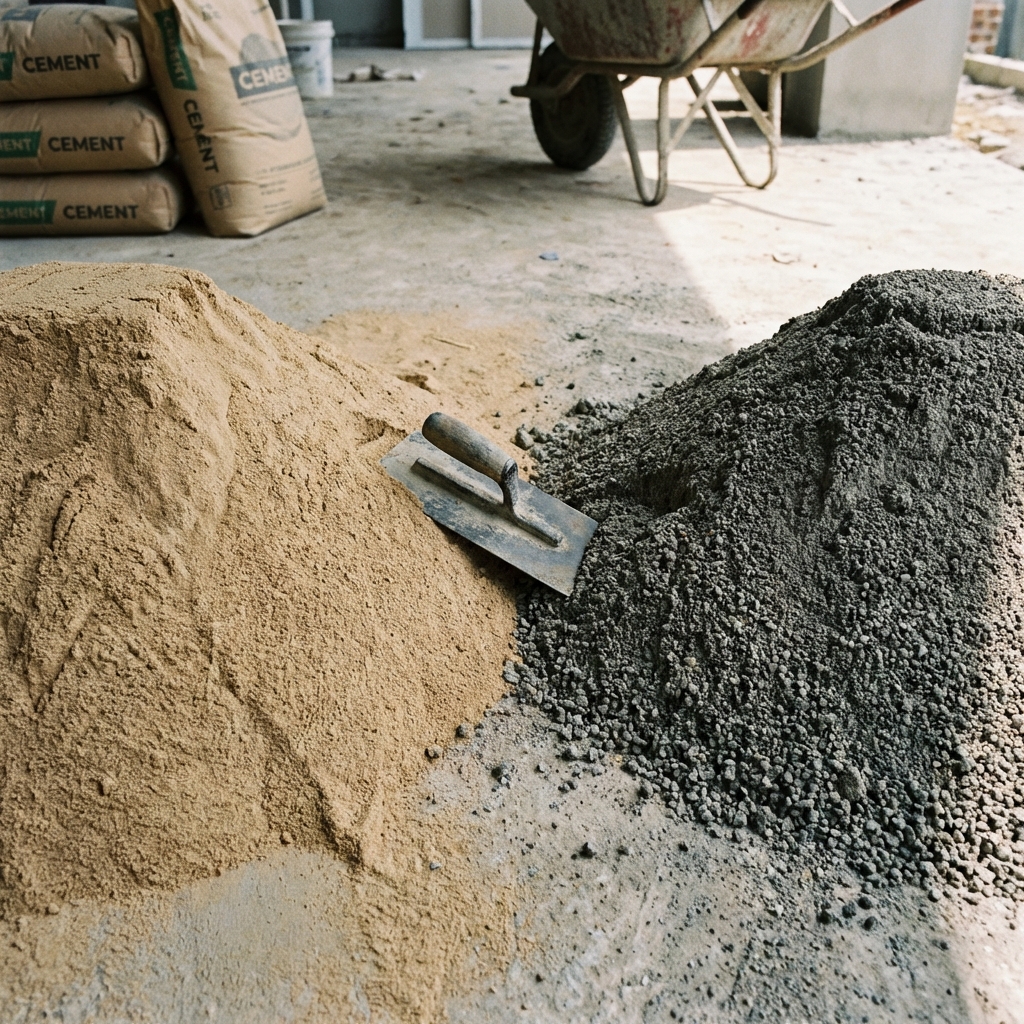
Plain cement concrete forms the hard, flat sub-floor over the gravel. Commonly an M10 or M15 nominal mix is used, at a thickness the drawing gives, with 20 mm blue metal as the aggregate. Set level pegs or screed guides across the room, place the concrete, and level it with a straight edge. Provide expansion or control joints in large areas as advised, and cure the PCC with water for several days. Use our construction material calculator to estimate the concrete volume for each room before ordering. Remember that doorways and bathrooms often need different levels, so mark them early.
Cement bedding and laying tiles
Once the PCC has cured, mark levels on the walls and use a cement and sand bedding to receive the tiles. Keep the bed uniform, press each tile firmly, and tap it level with a rubber mallet, checking with a spirit level. Avoid hollow spots under the tile, because they crack when loaded. Soak tiles if the manufacturer advises it, and keep joints even. After laying, protect the floor from traffic for a few days and cure the joints, following the tile maker's directions. Check the level again after a day, before the bedding dries fully and cannot be corrected.
Conclusion
A durable floor is built from the ground up: clean compacted filling, a levelled gravel layer, cured PCC and an even cement bedding. Spending care here costs little compared with re-laying cracked tiles later. Confirm thicknesses and the mix with your engineer. Call or WhatsApp +91 76676 66264 for delivered rates on gravel, kundu kal, sand, aggregate and cement for your floor in Tenkasi.
Reviewed by the TKR team. See our editorial policy for how guides are written, checked and updated.