M15, M20 and M25 are written as cement, sand and aggregate ratios, but a ratio alone does not certify strength. Learn nominal mixes, the 1.54 dry volume factor and how to estimate materials for a Tenkasi job.
What the grade names mean
M stands for mix and the number is the characteristic compressive strength in newtons per square millimetre after 28 days, so M20 is designed for 20 N/mm squared. Nominal mixes pair each grade with a volume ratio of cement to sand to aggregate. The commonly used pairings are M15 as 1:2:4, M20 as 1:1.5:3 and M25 as 1:1:2. M15 is typical for blinding and PCC, M20 for ordinary slabs, beams and columns in small houses, and M25 where the engineer specifies it. Always follow the grade your structural drawing states.
A ratio is not a certified grade
This is the point most people miss. Writing 1:1.5:3 on site does not make the concrete M20. Real strength depends on the cement quality, the sand and aggregate grading and cleanliness, the amount of water, mixing, compaction and curing. Only cube tests on the concrete you have actually made confirm strength. Ready mix plants and design mixes are controlled by weight and tested. If your engineer asks for a given grade on a structural member, ask what testing is needed instead of relying only on the ratio. When in doubt, ask your engineer which tests the member needs before the pour.
The dry volume factor of 1.54
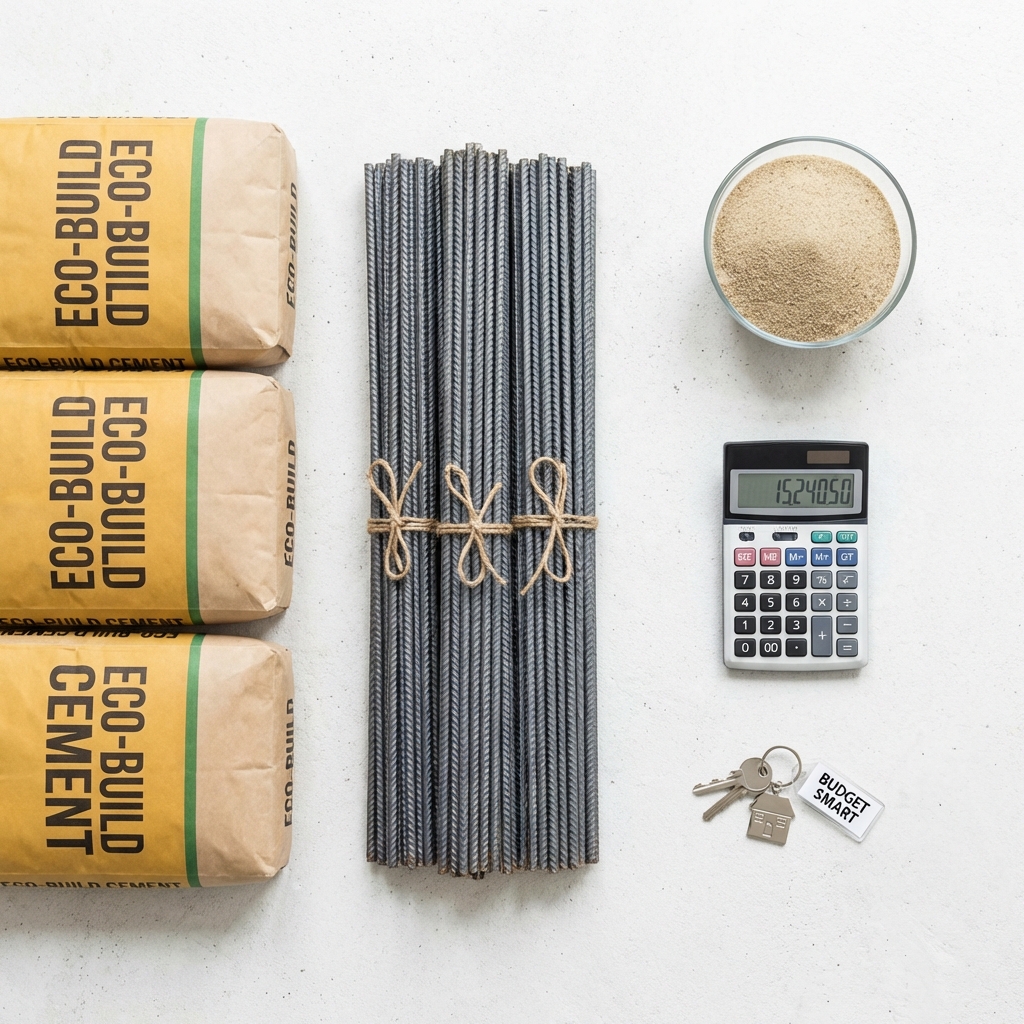
When water meets cement, sand and aggregate, the loose dry materials pack together and shrink in volume. To get one cubic metre of finished concrete you therefore need about 1.54 cubic metres of dry material, with extra allowed for the voids and wastage. Add the ratio parts, for example 1 plus 1.5 plus 3 equals 5.5 for M20, and each part is the dry volume divided by that sum. For M20 the cement share is 1.54 divided by 5.5, which is about 0.28 cubic metre, roughly eight 50 kg bags per cubic metre.
Quantities per cubic metre, roughly
Using the same method, M15 needs about 6.3 bags of cement, M20 about 8 bags and M25 about 11 bags per cubic metre of concrete, with sand and aggregate in proportion to the ratio. These are rounded and depend on how bag volume is taken, so treat them as a starting point only. Instead of doing the arithmetic by hand, enter your dimensions into our construction material calculator and use its figures, which are set up with the same factor. Then compare the output with your engineer's estimate before ordering.
Ordering and practical tips
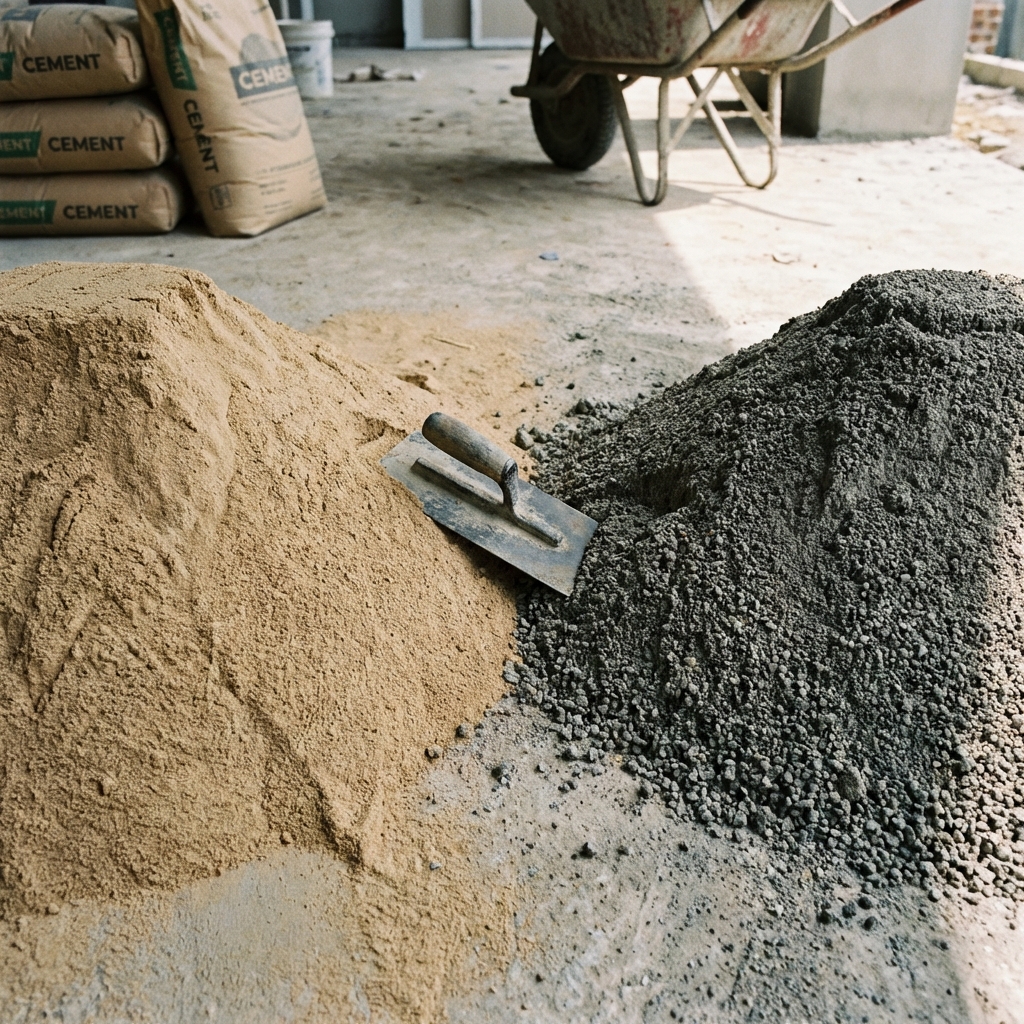
Measure sand and aggregate in a fixed container, such as a bottomless box or a bucket, rather than by the shovel, so the ratio stays consistent from batch to batch. Keep water to the minimum needed for workable concrete, since extra water weakens it. Use clean, graded sand and aggregate and vibrate or rod the concrete well into place. Choose M-Sand or P-Sand and 20 mm or 40 mm blue metal according to the member's thickness and reinforcement spacing. Our rate checker page lists current material prices, subject to availability and reconfirmation.
Conclusion
Nominal ratios such as 1:2:4, 1:1.5:3 and 1:1:2 give a practical way to estimate cement, sand and aggregate, and the 1.54 dry volume factor explains why you buy more than the finished volume. A ratio is not a certified grade, so follow your engineer's drawings and test where required. Call or WhatsApp +91 76676 66264 with your quantities for delivered rates on sand, aggregate and cement in Tenkasi.
Reviewed by the TKR team. See our editorial policy for how guides are written, checked and updated.