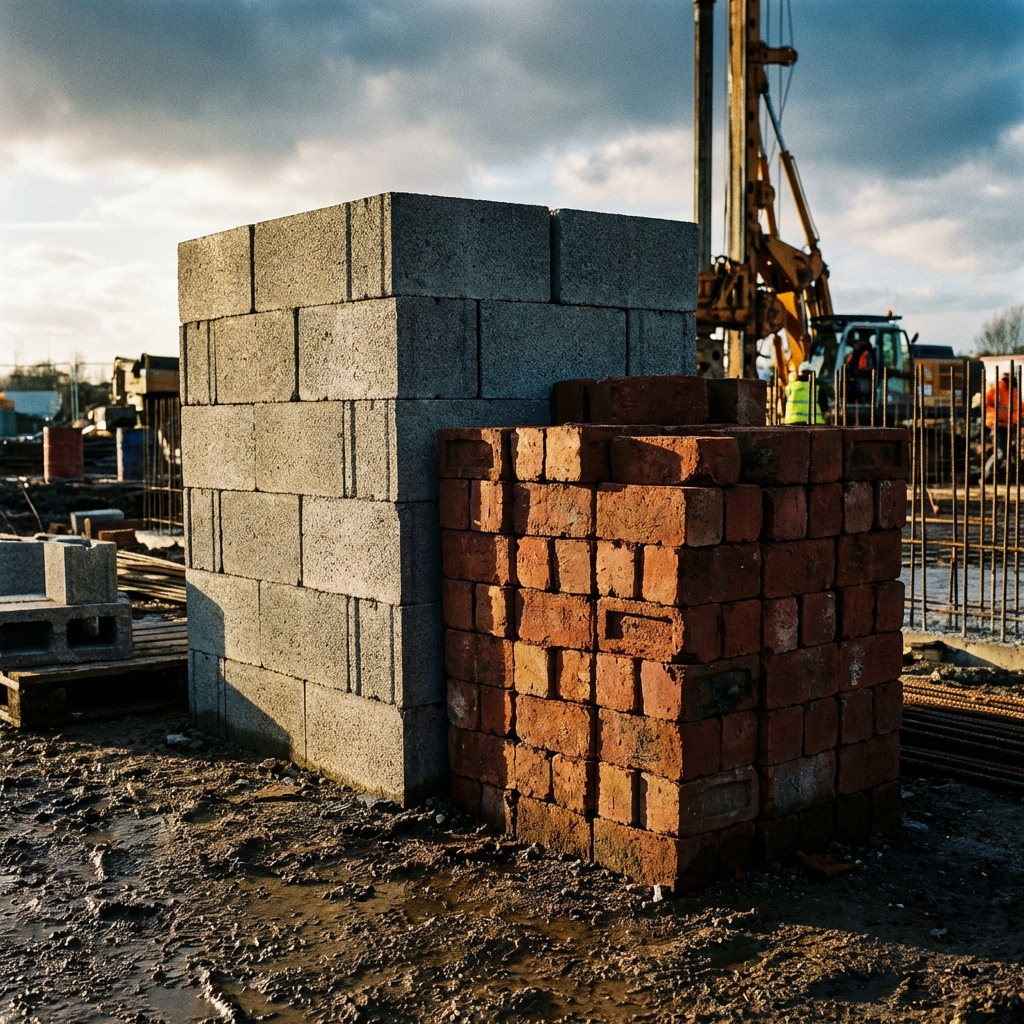
Cement blocks or red bricks? It is the first material decision on most house sites in Tenkasi, and it changes your wall cost, construction speed and how cool the house stays. This guide compares solid cement blocks and chamber (red clay) bricks on count per square foot, cost per square foot of wall, strength, water absorption and comfort, so you can pick the right one for each wall.
Size and how many you need per square foot
A standard chamber brick is about 9 x 4.5 x 3 inches, so a 9-inch wall needs roughly 10 to 11 bricks per square foot and a 4.5-inch partition about 5 to 6. A solid cement block is typically 16 x 8 inches on the face in 4, 6 or 8 inch thickness, so you need only about 1.1 to 1.2 blocks per square foot. Fewer pieces means fewer joints, less mortar and faster laying.
Cost per square foot of finished wall
Compare the finished wall, not the piece price. Bricks are cheaper each, but a brick wall uses nine to ten times as many pieces, far more mortar, more mason hours and a thicker plaster coat to level the surface. A block wall uses less mortar, lays two to three times faster and takes a thinner plaster. On most Tenkasi sites the block wall works out cheaper per square foot once labour and plaster are counted. Ask us for current block and brick rates and we will cost both for your wall area.
Strength and load-bearing use
Good machine-pressed solid blocks reach compressive strengths comparable to or higher than typical chamber bricks and are very uniform, which engineers like for load-bearing single and double storey houses. Red bricks vary more from kiln to kiln. In an RCC-framed house the frame carries the load, so both work as infill and the choice comes down to cost, comfort and speed.
Heat, rain and comfort in the Tenkasi climate
Red clay bricks breathe and have better natural thermal insulation, so brick houses stay a little cooler in April and May. Cement blocks conduct more heat but this is largely offset by plaster, paint and a ventilated roof. In the monsoon, dense cement blocks absorb less water than porous bricks and are less prone to efflorescence and damp patches on external walls.
Speed and plaster finish
Because blocks are large and uniform, a mason lays far more wall area per day and the surface comes out flatter, so plaster can be 12 mm instead of 15 to 20 mm. That saves P-Sand and cement and shortens the schedule, which matters when you are paying daily labour.
Which should you choose?
Choose solid cement blocks for external walls, compound walls, load-bearing walls in small houses and anywhere speed and cost per square foot matter most. Choose red bricks where you want exposed brickwork, traditional detailing or the best natural thermal comfort. Many Tenkasi houses use blocks for the structure and bricks for feature walls. For light upper-floor partitions, also consider hollow blocks or AAC blocks.
Conclusion
For most new houses in Tenkasi district, solid cement blocks give the lower cost per square foot of wall, faster construction and better monsoon performance. Red bricks still win on natural cooling and looks. TKR Building Materials stocks both, along with hollow blocks and the M-Sand and cement you need to lay them, and will help you count the pieces for your plan. Call or WhatsApp +91 76676 66264 for today’s rates.
Reviewed by the TKR team. See our editorial policy for how guides are written, checked and updated.