Fly ash bricks have moved from government projects into ordinary house sites across Tamil Nadu, and more Tenkasi builders now ask whether they should replace red clay bricks. This guide compares the two on strength, water absorption, finish, cost and availability so you can decide wall by wall.
What fly ash bricks are
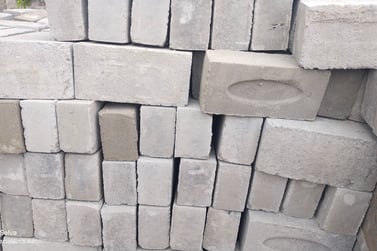
Fly ash bricks are made from fly ash, the fine residue from coal-fired power plants, mixed with lime, gypsum and sand or stone dust, pressed in a machine and cured with water rather than fired in a kiln. The result is a grey, sharp-edged, very uniform brick. Red bricks are moulded from clay and fired in a chamber kiln, which gives them their colour and their variability.
Strength and uniformity
Machine-pressed fly ash bricks usually test at higher compressive strength than ordinary chamber bricks and vary much less from piece to piece. Because they are made to a fixed size, walls come up straight with thin, even joints. Red bricks from a good kiln are strong enough for any house, but a poor batch can have soft, under-fired pieces that crumble.
Water absorption and the monsoon
Fly ash bricks typically absorb less water than clay bricks, so external walls take on less moisture during the north-east monsoon and show less efflorescence, the white salt bloom that appears on damp brick walls. Lower absorption also means the brick pulls less water out of fresh mortar, giving a better bond when bricks are wetted properly before laying.
Plaster, finish and cost
Because fly ash bricks are flat and true, the plaster coat can be thinner and uses less P-Sand and cement. Per piece, fly ash bricks are often similar in price to good chamber bricks, so the saving comes from mortar, plaster and faster laying rather than from the brick itself. Ask for both rates and compare per square foot of finished wall, not per brick.
Where red bricks still make sense
Red bricks have better natural thermal insulation and the warm colour needed for exposed brickwork, compound walls with brick detailing and traditional Tamil house styles. They are also easier to cut and chase for conduits. If the look matters or you want exposed walls, red bricks remain the choice.
Availability in Tenkasi district
Fly ash supply in southern Tamil Nadu comes mainly from the Tuticorin thermal plants, so fly ash bricks are readily available in and around Tenkasi. Supply is steady year-round, unlike kiln bricks, which can run short after heavy rain disrupts firing. Both are delivered by tipper or lorry to your site.
Conclusion
For plastered external and internal walls, fly ash bricks give a straighter, drier, more uniform wall with thinner plaster, and often a lower cost per square foot once labour is counted. For exposed brickwork and the best natural cooling, red bricks still win. TKR Building Materials supplies both types in Tenkasi district along with the sand and cement to lay them. Call or WhatsApp +91 76676 66264 for a delivered quote.
Reviewed by the TKR team. See our editorial policy for how guides are written, checked and updated.